
Hydrogen is the simplest element in the universe and can be produced using any primary energy source, including renewable energy sources. This makes the hydrogen a potentially unlimited resource. Hydrogen is able to create a 100% neutral pure energy without emission of greenhouse gases. Thus the hydrogen protects our environment by providing pure electric energy for our everyday life, where this energy can be applied in industry, transport and other sectors, as well as for other substantial needs.
The Advantages of Hydrogen Fuel:
Human society is in need of a constant, stable economic growth, energy security and actions intended for environmental protection and decline in harmful climate change. Hydrogen technologies can therefore achieve the following goals:
History: The developments leading to an operational fuel cell can be traced back to the early 1800's with Sir William Grove recognized as the discoverer in 1839. Throughout the remainder of the century, scientists attempted to develop fuel cells using various fuels and electrolytes. Further work in the first half of the 20th century served as the foundation for systems eventually used in the Gemini and Apollo space flights. However, it was not until 1959 that Francis T. Bacon successfully demonstrated the first fully operational fuel cell. Proton exchange membrane fuel cells were first used by NASA in the 1960's as part of the Gemini space program, and were used on seven missions. Those fuel cells used pure oxygen and hydrogen as the reactant gases and were smallscale, expensive and not commercially viable. NASA's interest pushed further development, as did the energy crisis in 1973. Since then, fuel cell research has continued unabated and fuel cells have been used successfully in a wide variety of applications.
Fuel cells can provide heat and electricity for buildings and electrical power for vehicles and electronic devices.
How Fuel Cells Work
Fuel cells work like batteries, but they do not run down or need recharging. They produce electricity and heat as long as fuel is supplied. A fuel cell consists of two electrodes-a negative electrode (or anode) and a positive electrode (or cathode)-sandwiched around an electrolyte. A fuel, such as hydrogen, is fed to the anode, and air is fed to the cathode. In a polymer electrolyte membrane fuel cell, a catalyst separates hydrogen atoms into protons and electrons, which take different paths to the cathode.
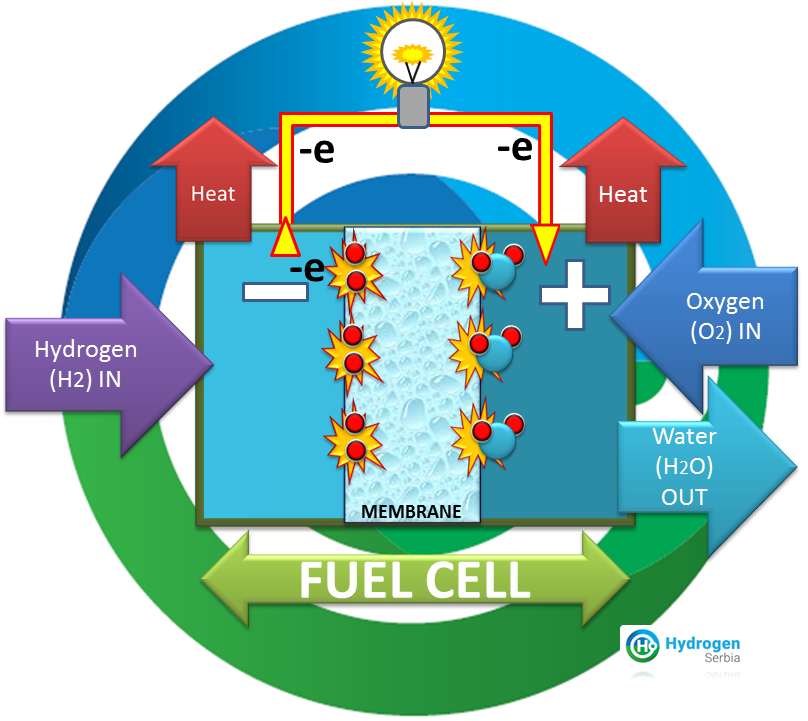
The electrons go through an external circuit, creating a flow of electricity. The protons migrate through the electrolyte to the cathode, where they reunite with oxygen and the electrons to produce water and heat
Types of Fuel Cells
Although the basic operations of all fuel cells are the same, special varieties have been developed to take advantage of different electrolytes and serve different application needs. The fuel and the charged species migrating through the electrolyte may be different, but the principle is the same. An oxidation occurs at the anode, while a reduction occurs at the cathode. The two reactions are connected by a charged species that migrates through the electrolyte and electrons that flow through the external circuit.
Polimer electrolyte membrane fuel cells
Polymer electrolyte membrane (PEM) fuel cells, also called proton exchange membrane fuel cells, use a proton-conducting polymer membrane as the electrolyte. Hydrogen is typically used as the fuel. These cells operate at relatively low temperatures and can quickly vary their output to meet shifting power demands. PEM fuel cells are the best candidates for powering automobiles. They can also be used for stationary power production. However, due to their low operating temperature, they cannot directly use hydrocarbon fuels, such as natural gas, liquefied natural gas, or ethanol. These fuels must be converted to hydrogen in a fuel reformer to be able to be used by a PEM fuel cell.
Direct methanol fuel cells
The direct-methanol fuel cell (DMFC) is similar to the PEM cell in that it uses a proton conducting polymer membrane as an electrolyte. However, DMFCs use methanol directly on the anode, which eliminates the need for a fuel reformer. DMFCs are of interest for powering portable electronic devices, such as laptop computers and battery rechargers. Methanol provides a higher energy density than hydrogen, which makes it an attractive fuel for portable devices.
Alkaline fuel cells
Alkaline fuel cells use an alkaline electrolyte such as potassium hydroxide or an alkaline membrane that conducts hydroxide ions rather than protons. Originally used by the National Aeronautics and Space Administration (NASA) on space missions, alkaline fuel cells are now finding new applications, such as in portable power.
Phosphoric acid fuel cells
Phosphoric acid fuel cells use a phosphoric acid electrolyte that conducts protons held inside a porous matrix, and operate at about 200°C. They are typically used in modules of 400 kW or greater and are being used for stationary power production in hotels, hospitals, grocery stores, and office buildings, where waste heat can also be used. Phosphoric acid can also be immobilized in polymer membranes, and fuel cells using these membranes are of interest for a variety of stationary power applications.
Molten carbonate fuel cells
Molten carbonate fuel cells use a molten carbonate salt immobilized in a porous matrix that conducts carbonate ions as their electrolyte. They are already being used in a variety of medium-to-large-scale stationary applications, where their high efficiency produces net energy savings. Their high-temperature operation (approximately 600°C) enables them to internally reform fuels such as natural gas and biogas.
Solid oxide fuel cells
Solid oxide fuel cells use a thin layer of ceramic as a solid electrolyte that conducts oxide ions. They are being developed for use in a variety of stationary power applications, as well as in auxiliary power devices for heavy-duty trucks. Operating at 700°C-1,000°C with zirconia-based electrolytes, and as low as 500°C with ceria-based electrolytes, these fuel cells can internally reform natural gas and biogas, and can be combined with a gas turbine to produce electrical efficiencies as high as 75%.
Combined heat and power fuel cells
In addition to electricity, fuel cells produce heat. This heat can be used to fulfill heating needs, including hot water and space heating. Combined heat and power fuel cells are of interest for powering houses and buildings, where total efficiency as high as 90% is achievable. This high-efficiency operation saves money, saves energy, and reduces greenhouse gas emissions.
Regenerative or reversible fuel cells
This special class of fuel cells produces electricity from hydrogen and oxygen, but can be reversed and powered with electricity to produce hydrogen and oxygen. This emerging technology could provide storage of excess energy produced by intermittent renewable energy sources, such as wind and solar power stations, releasing this energy during times of low power production.
Hydrogen is a clean fuel that, when consumed in a fuel cell, produces only water. Hydrogen can be produced from a variety of domestic resources, such as natural gas, nuclear power, biomass, and renewable power like solar and wind. These qualities make it an attractive fuel option for transportation and electricity generation applications. It can be used in cars, in houses, for portable power, and in many more applications. Hydrogen is an energy carrier that can be used to store, move, and deliver energy produced from other sources. Today, hydrogen fuel can be produced through several methods. The most common methods today are natural gas reforming (a thermal process), and electrolysis. Other methods include solar-driven and biological processes.
Thermal processes for hydrogen production typically involve steam reforming, a high-temperature process in which steam reacts with a hydrocarbon fuel to produce hydrogen. Many hydrocarbon fuels can be reformed to produce hydrogen, including natural gas, diesel, renewable liquid fuels, gasified coal, or gasified biomass. Today, about 95% of all hydrogen is produced from steam reforming of natural gas.
Water can be separated into oxygen and hydrogen through a process called electrolysis. Electrolytic processes take place in an electrolyzer, which functions much like a fuel cell in reverse-instead of using the energy of a hydrogen molecule, like a fuel cell does, an electrolyzer creates hydrogen from water molecules.
Solar-driven processes use light as the agent for hydrogen production. There are a few solar-driven processes, including photobiological, photoelectrochemical, and solar thermochemical. Photobiological processes use the natural photosynthetic activity of bacteria and green algae to produce hydrogen. Photoelectrochemical processes use specialized semiconductors to separate water into hydrogen and oxygen. Solar thermochemical hydrogen production uses concentrated solar power to drive water splitting reactions often along with other species such as metal oxides.
Biological processes use microbes such as bacteria and microalgae and can produce hydrogen through biological reactions. In microbial biomass conversion, the microbes break down organic matter like biomass or wastewater to produce hydrogen, while in photobiological processes the microbes use sunlight as the energy source.